Not Your Parents' Schoolhouse Rock: Getting Tech Policy Done in a Non-Functioning Congress
Jeff Rothblum, Michael Flynn
Policy Village
 Policy @ DEF CON
Hackers meet policymakers
We bring hackers and policymakers together to work on the laws, standards, and decisions that shape technology.
DEF CON 34 · Agency · August 6–9, 2026
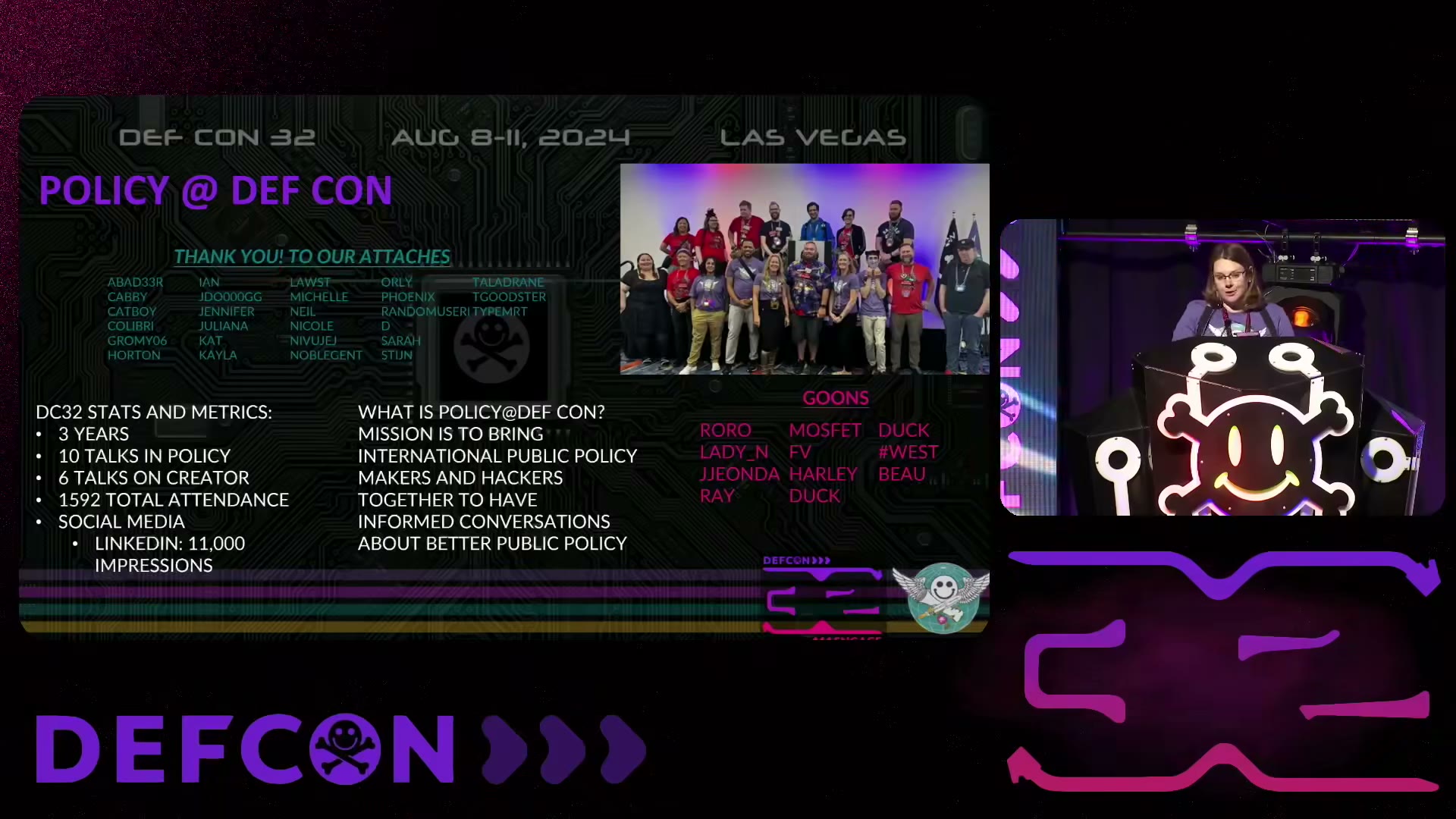
From the archive · DEF CON 32 / 2024
Katie Noble explains why Policy brings this community together, thanks the team, and shares the year’s results.
These are 2024 figures from the closing slide, not DC34 totals.
Read the closing transcript · Policy starts at 25:13.
More Policy videosDEF CON 34 / 2026
AI accountability, vulnerability disclosure, healthcare, election security, and digital rights. The published program lists 29 sessions across Policy Village and the Creator Stages.
Jeff Rothblum, Michael Flynn
Policy Village
Christian Dameff, Jeff "r3plicant" Tully
Policy Village
Lester Godsey, William Gates, Tim Harper
Policy Village
Matthew Wein, Bruce Schneier, Chris Painter, Heather West
Policy Village
Szymon Skalski, Patricia Vargas Leon, Jorge Acevedo Canabal
Creator Stage 1
John Banghart, Elizabeth Eigner, Lisa Olsen, Lindsey Cerkovnik
Policy Village
Alec Summers, Lindsey Cerkovnik, Madison Ficorelli
Policy Village
Cindy Cohn
Creator Stage 1
Katharina "Kat S" Sommer
Creator Stage 1
Katherine Pratt, Jeff Rothblum, Maurice Turner, Ayan Islam, Beau Woods
Policy Village
Andreas Kaltsounis, Jacob Wall
Creator Stage 1
Grant Versfeld, David "0xdf" Forsythe
Policy Village
Nuno Rodrigues Carvalho, Razvan Gavrila
Policy Village
Joe Uchill
Policy Village
Lindsey Cerkovnik, John Banghart, Ben Flatgard, Elizabeth Eigner
Policy Village
Travis Berent, Adam Hickey
Policy Village
Sahan Fernando, James Bowie, Nancy Brainerd, Phil Englert
Policy Village
Joshua Marpet
Creator Stage 1
Taylor Roberts, Mitch Herckis, Katie Trimble-Noble, Razvan Gavrila
Policy Village
Michael Brennan, Nadine Farid Johnson, Rebekah Brown
Policy Village
Raymond Sheh, Martin Stanley
Policy Village
Thorin Klosowski, Cooper "Cybertiger" Quintin, Alexis Hancock, Cindy Cohn, Rory Mir
Policy Village
Archived schedule; all times PDT. Session titles link to the published descriptions. The Saturday surprise slot remains unnamed in Hacker Tracker.
Beyond the talks · 2026
Capture the Vote
Our DC34 policy challenge put players in front of a fictional congressional office: get past the front desk, make a case, and earn a staffer’s time. The practice edition is available to play.
Play Capture the VotePolicy Mixer · August 7
The Friday happy hour brought people together at 6:30 p.m. It also had a plate-smashing station. Yes, really.
Mixer listingFrom the archive · 2023–2025
Full talks and a panel from past Policy programs, published by DEF CON.
Tanya makes the case for secure coding policy and shares ways to push governments to improve their software.
Read transcriptJordan Kasper
Jordan walks through federal open-source policy, the obstacles agencies face, and what could work better.
Read transcriptAvi McGrady
Avi argues for teaching privacy, security, and online safety throughout K–12 education.
Read transcriptPolicy panel
Government representatives discuss software security, procurement, standards, and working with the hacker community.
Read transcriptPolicy @ DEF CON
The team's short introduction to the 2025 program, published before the conference.
Harley Geiger
Harley's introduction to the 2024 Policy program, recorded before that year's event.
English auto-captions are available on YouTube; captions and transcripts may contain errors. These recordings reflect their event year.
Keep digging
2025 · Starts at 39:17. The team reported hundreds of CTF players and more than 20 talks, including critical infrastructure, encryption, and education.
2025 · Survey results (PDF). The annual survey returned to the DC34 program with Matthew Wein, Bruce Schneier, Chris Painter, and Heather West.
Interviews and program previews. Conference recordings are also published by DEF CON.